:

Differentiation:
Helping All Students Reach Their Full Potential
Last spring, Friends Select School employees came together for a day of professional learning centered on differentiation, a teaching approach grounded in the belief that all of our students deserve learning experiences that help them grow, thrive, and reach their full potential.
Although this strategy has long been part of Friends Select classrooms, we have a renewed, more deliberate focus on examining, strengthening, and celebrating those practices.
Led by the division directors at Friends Select, director of city curriculum Margaret Smith, and director of equity and inclusion Toni Graves Williamson, the day encouraged employees to examine how differentiation supports the school’s commitment to excellence in teaching and learning. “We are constantly reflecting on teaching and learning, and the goal of differentiation was to make sure that we are challenging all students,” said Margaret. “This is work that has been happening, but we wanted to dedicate time, energy, and resources to an intentional self-assessment: Where are we already differentiating? Where might we do it more? And how can we do it more effectively?”
To deepen those conversations, Friends Select welcomed educator and researcher Dr. Tom Brinkerhoff, whose experience in independent schools, including Princeton Day School, helped frame differentiation as a way to engage every learner in rigorous work. Teachers then spent the afternoon collaborating to redesign lessons with differentiation embedded from the outset. Rather than viewing it as support for only a few students, teachers focused on creating classrooms where all students engage with the same rich content while having opportunities to extend their thinking. As Margaret explained, the goal is to raise the ceiling for all students, ensuring every learner is challenged to grow, and that everyone engages with the same rich content while creating opportunities for each learner to extend the thinking process and pursue deeper levels of understanding.
Building a Daily Practice in Lower School
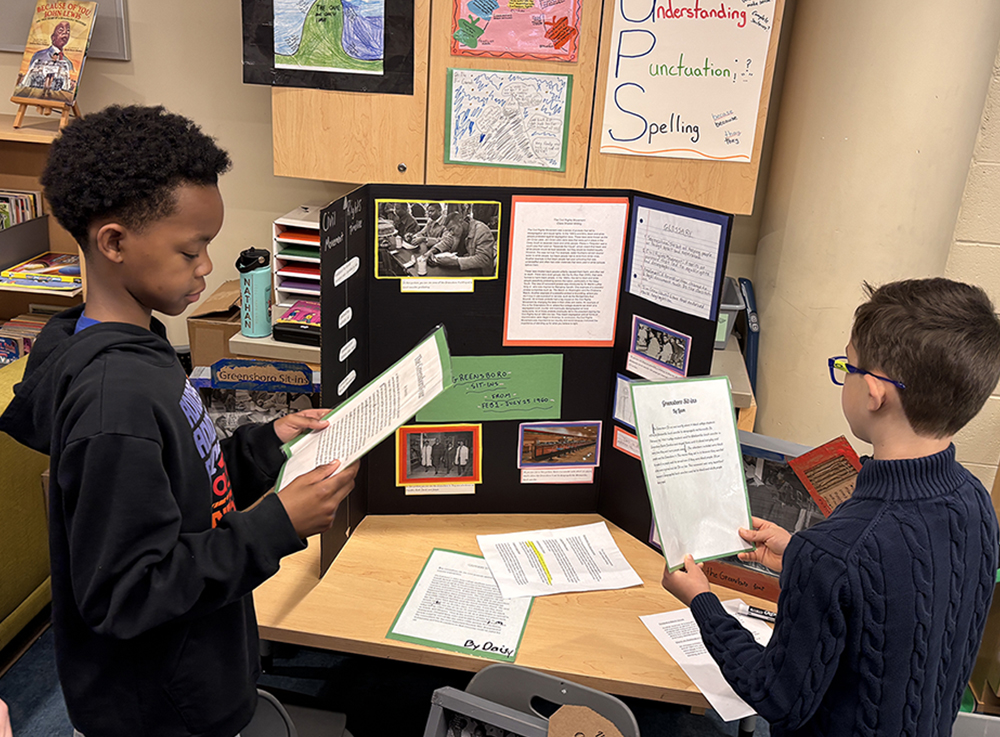
For fourth grade teacher Mira David P’38, differentiation is a daily practice that reflects her commitment to knowing each student deeply and responding to each one’s unique strengths and needs. In practice, Mira might provide graphic organizers or sentence starters during writing, use formative math assessments to determine which students need additional support or challenges, or create opportunities for students to extend their learning beyond core classroom expectations. Inspired by professional learning at the National Association for Gifted Children conference, Mira recently introduced ThinkDots, a menu of optional, unit-based social studies projects that allows students to explore topics through creative writing, visual arts, and other formats. Rather than assigning a single extension activity, ThinkDots gives students multiple pathways to demonstrate understanding while pursuing deeper inquiry in ways that reflect their individual interests and strengths.
For a social studies unit on the Underground Railroad, Mira’s students studied the work of abolitionists and answered a challenging question: When, if ever, is it appropriate to break the law? Students then shared their opinions, supported by sentence stems that helped them build on one another’s ideas, respectfully disagree, and understand multiple perspectives. Mira tailored questions to enable different conversation entry points for students, encouraging more profound analysis and fostering a conversation in which every student could engage and receive the support needed to participate successfully. “Through this process, I felt confident that every child could access the higher-order questions. I also knew that every child had the scaffolding to push thinking deeper because I was able to orchestrate the discussion through the shared sentence stems we had been practicing,” she said.
Raising the Bar in Middle School
In Erik Hermans’ P’34 middle school classroom, differentiation begins with a rigorous curriculum that challenges every student. “My experience as a teacher is that if you raise the bar for everyone, the majority of kids will meet it,” he said. From that shared foundation, he identifies students who are ready to go further, offering what he calls frustration-level assignments that are intentionally designed to be just beyond their current abilities.
In fifth grade mythology, for example, students move beyond retelling familiar stories to tackling abstract questions about why religious traditions function as they do. Erik doesn’t expect students to always answer correctly; instead, the goal is to stretch their thinking, helping them discover what they can reason independently. “Just pushing their thinking and seeing where they get stuck or what they can figure out by themselves is interesting for me to see,” he said. “It’s also fun for them because these are the kind of kids who just like to puzzle over a problem.”
These challenges are woven seamlessly into the regular flow of class. Although everyone receives the same core instruction, students who master concepts quickly can work independently on extension assignments. For many students, the opportunity itself is deeply affirming. “They’re often proud of the fact that they’re asked to do more,” he reflected. “I recognize that they’re ahead of the curriculum, that they can handle more work. That in itself is a form of recognition for them.”
Pursuing More Complex Analysis in Upper School
Upper school science teacher Monica Higgins P’34, ’38 sees differentiation as a way for students to build a strong foundation while also engaging with the complexity and nuance that define authentic scientific inquiry. In her Chemistry classroom, that often means creating opportunities for students who are ready to move beyond the core curriculum to pursue deeper questions, make connections, and think like practicing scientists.
In a unit on acids and bases, students learned the Arrhenius and Brønsted-Lowry classification systems before applying their knowledge by classifying substances as acids, bases, both, or neither. Anticipating that some students might want to dig deeper, Monica prepared enrichment work introducing Lewis acids and bases, a more advanced classification system. Although students ultimately found the Brønsted-Lowry framework sufficiently challenging, having the additional material available ensured that learners could move further if they were ready.
Monica sees differentiation as an opportunity to invite students beyond foundational knowledge and into scientific inquiry. Her classes provide students with the essential frameworks they need, but she also creates opportunities for those ready to explore the complexity beyond the curriculum. “Science is immensely complex, and as their teacher, part of what I do is use my knowledge and resources to distill it into a reasonable amount of information for them,” she explained. “I like to design exploration work to tap into their understanding that things aren’t as simple as they seem, and to reward them for their curiosity with a fuller picture of the scientific knowledge on a specific subject.” For Monica, the most meaningful learning happens when students pursue authentic questions of their own.
Reflecting Our Quaker Values
Across every division, differentiation is more than an instructional strategy; it is a natural expression of Friends Select’s Quaker commitment to honoring the Light in every young learner. Through ongoing professional learning, collaboration, and reflection, Friends Select faculty are intentionally designing classrooms in which all students engage in rich, shared learning while receiving the support and challenge they need.
“Every student deserves to be challenged in ways that stretch them at their appropriate level. When students see themselves doing hard things, it naturally boosts their confidence,” shared Mira. “Being adept at differentiation is directly linked to our values as a school because it is only through differentiation that our classrooms can really be inclusive spaces where every child can shine.”