
Learning Beyond the Classroom
A Student-Centered Approach with Independent Studies, Explorations, and Internships |
Upper school students at Friends Select School know firsthand that learning is not confined to the classroom. Through independent studies, independent explorations, and senior internship projects, they are encouraged to follow their passions and curiosities. From delving into an academic subject beyond the course catalog to exploring professional sectors of Philadelphia, these signature programs highlight the school’s commitment to student agency, experiential learning, and academic rigor by providing juniors and seniors the opportunity to design self-directed work that prepares them for college and life beyond Friends Select. |
Pursuing Independent Studies and Explorations
Independent studies and explorations enable students to pursue interests beyond the curriculum, either after completing all courses in a subject or when their curiosity surpasses what is offered. To participate, students must demonstrate commitment through prior work, recognized potential or developing interest, along with personal responsibility. Working with a faculty advisor, interested students develop course proposals—including the purpose, sources, learning activities, assessments, and timelines—that are submitted to the upper school dean of academics, Natalie Mayer P’32, who reviews and approves with the Department Chair Committee group. “As we prepare students for the whole of life, and as students get ready for college and beyond, this is a way for them to dive deeper into their interests, to learn how they can apply their interests to real-world careers and studies, how to better communicate with outside communities, and how to see how what they’ve been studying applies to the world outside of the classroom walls,” Natalie said.
Independent studies are a significant undertaking, requiring students to spend at least three hours per week plus time for direct collaboration with a faculty advisor. The workload and assessments follow a traditional course and culminate in a final presentation. Students earn academic credit, receive a letter grade that appears on reports and transcripts, and have that grade included in their GPA. Independent explorations, by contrast, offer a more flexible and less formal pathway for pursuing a particular interest. Time for coursework and meetings with an advisor are shorter; expectations and assessments are determined collaboratively; and a final presentation is optional. These explorations appear on transcripts as “pass/fail” and do not carry academic credit or impact GPA.
Learning Computer-Aided Design to Study Architecture
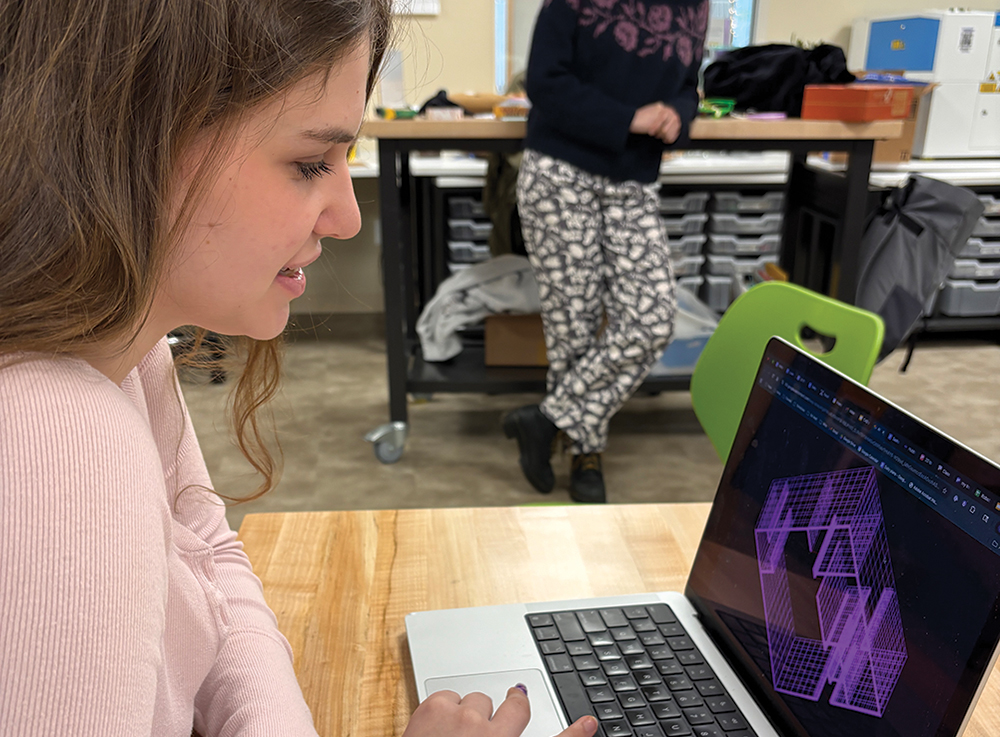
To support her interest in architecture and desire to gain hands-on experience with design tools, Sasha ’26 developed a foundational skills course in computer-aided design (CAD) using a structured Autodesk curriculum that combined instructional videos with project-based learning, working in platforms including Revit and AutoCAD. Learning CAD was created for students considering a future in architecture or related fields, emphasizing professional practice, accountability, and self-directed learning. Sasha documented her work through mini-projects and reflections, culminating in a portfolio that showcased her growth and learning throughout the fall semester.
Middle and upper school STEAM teacher Luisa Levine served as the faculty advisor for the independent study and was drawn to its strong interdisciplinary potential. “I found the course to be an excellent model for multidisciplinary learning, because it integrates art, design, history, technology, engineering, and math,” she explained. Luisa also saw the course as an opportunity for Sasha to build confidence with technology firsthand, noting that as students’ technical skills grow, so does their ability to think imaginatively and meaningfully about the world they are designing. She explained, “It’s awesome seeing students gain independence in the programs over time and start leveraging their creative thinking to make something original. For example, a floor plan for a wealthy bachelor or a family of four in Chestnut Hill. Their technical growth allows them to show more creativity and thinking about the world.”
Independent studies and explorations highlight the growth students encounter when given ownership over their learning, and for Sasha, it was an empowering experience. “Independent studies show that Friends Select allows students to guide their own learning, and put time and effort into things they want to do,” Sasha explained.
Luisa shares Sasha’s perspective on the impact and added, “I deeply value the nonhierarchical learning model at FriendsSelect, which I feel is highlighted in this independent study. The students have autonomy and take accountability for their learning and are there because they are really intrinsically motivated. I can act as a facilitator and a helper, but ultimately the students’ interest leads the way, and I feel lucky to be part of the joy of learning.”
Engaging in Senior Internships and Independent Projects
An eagerly anticipated culminating experience for graduating students, the senior internship project further reflects a commitment to student-led learning. After completing regular coursework and final exams in mid-May, seniors spend three weeks in Philadelphia, engaging in internships or independent projects tailored to their individual interests. Designed to introduce students to professional environments, service work, product development, and cultural, artistic, or scientific research, the senior internship project allows students to explore potential career paths while connecting them to the city and its resources.
Seniors seek internships that align with their interests, identifying opportunities through the school’s robust Internship Directory and direct support from faculty, including upper school learning specialist and internship coordinator Elyse Wilson, director of city curriculum Margaret Smith, and director of the Friends Select Fund and constituent engagement Molly Mullahy P’33. “Through their work with Molly, in particular, students gain access to our extensive alumni and parent networks, connecting them with professionals who can support and deepen their interests,” said Chris Singler P’20, ’22, ’27, director of upper school. For instance, internship partners include InLiquid (Rachel Zimmerman ’85), Scribe Video Center (Louis Massiah ’72), and the University of Pennsylvania Department of Physics and Astronomy (Bhuvnesh Jain P’27).
In addition to their placements, students may pursue an independent project connected to their internship, guided by a mentor who typically dedicates up to 75 hours of support during the month. “Overwhelmingly, what we see is how impressed our mentors are with our students, and similarly, how grateful our students are to their mentors. I have seen summer jobs and college internships emerge from our internship program,” said Chris.
The internship program is particularly valuable at this stage of students’ academic careers, offering challenging, real-world experiences that help seniors develop accountability, professional skills, and a bridge between school and life after graduation. Seniors gain practical life skills, including writing effective resumes and professional emails, dressing appropriately, and making meaningful contributions to an organization. “I think the internship program is a great ‘icing on the cake’ for how we prepare students for the whole of life,” Chris added.
The independent studies, explorations, and senior internships reflect Friends Select’s student-centered holistic approach to education. “What I sense is that students not only feel accomplished as they engage of this deeper learning, but they tend to take more ownership in their learning because it’s something they helped plan and create,” Natalie reflected. “In line with the school’s academic philosophy that students should find joy and meaning in their education, these programs aim to provide them with opportunities to push their learning in pursuit of deeper scholarship, analysis, and understanding.”